In the beauty and spa industry, burnout is often worn like a badge of honour. Long hours, back -to-back appointments, emotional labour with clients, and relentless performance expectations are often seen as part of the job. When exhaustion sets in, the conversation usually turns to time off, team motivation, or productivity tools. But what if burnout is not a workload issue at all? What if it is a structural design flaw?
BEYOND BURNOUT: REDEFINING OCCUPATIONAL WELLNESS
For Priya Chaphekar, Founder, Priyog Wellness and Co-founder of Mind and Mat Co., occupational wellness is fundamentally relational. “Occupational wellness isn’t just about managing workload or avoiding burnout. It’s more about the relationship you have with your work.” From a holistic lens, she says, work is not separate from the body. “You can see it in your shoulders, your jaw, your breath. If your work constantly makes you shrink or brace, no productivity tool is going to solve that.”
Paayal Lal, Founder, EKA Wellness, frames it through nervous system science. “At EKA, we define occupational wellness as the ability to engage in meaningful work while maintaining nervous system regulation, finding a balance between personal meaning and a professional life and maintaining a stable sense of self at the end of the day.” She is clear that burnout is not the starting point. “Burnout is the result of prolonged dysregulation, not the starting point.”
OCCUPATIONAL WELLNESS
isn’t just about managing
WORKLOAD
or avoiding
BURNOUT
. It’s more
ABOUT THE RELATIONSHIP
you have with
YOUR WORK
.
— Priya Chaphekar
THE BIOLOGY OF CLOSURE
In salons and spas, where emotional presence is constant, work rarely feels complete. Messages continue, client feedback lingers, and targets loom. “When work never truly closes, the body never really relaxes,” says Chaphekar. “Even if the laptop is shut, something inside is still switched on.” She goes on to explain that over time, sleep becomes lighter and the body remains subtly braced.
Lal is direct about the consequences. “The need for closure is not a luxury. It is a biological requirement.” Without it, cortisol stays elevated and the stress response never fully powers down. The result is “chronic fatigue but with a wired energy.”
For high performers in the beauty business, that unfinished loop becomes an identity trap, where productivity replaces rest as proof of worth.
The
NEED FOR CLOSURE
is not a
LUXURY
. It is a
BIOLOGICAL REQUIREMENT.
— Paayal Lal
CONTEXT SWITCHING AND CONSTANT AVAILABILITY
Leadership in the beauty and spa sector often requires rapid shifts between therapist, manager, problem solver, and brand ambassador. The cost of that constant switching is rarely acknowledged. “When someone is constantly switching contexts and always available, the nervous system never fully relaxes,” Chaphekar explains. What appears as efficiency externally can feel like restlessness and impatience internally.
Lal offers a metaphor that resonates in an industry built on tools and equipment. “Think of your phone or your car. What happens if they are left running all the time. They crash. They hang. And we are humans. Not machines.” Repeated activation without recovery leaves the body reactive and mentally fragmented.
STRESS OR SYSTEM BREAKDOWN
Busy seasons are inevitable in beauty. Festive calendars fill up and wedding appointments stack back-to-back. The key difference lies in recovery. “Temporary stress will resolve through rest,” Lal says. “If rest restores you, it is stress. And if it doesn’t, it is a system breakdown.” A deeper breakdown begins to show up as emotional numbness and persistent fatigue.
Chaphekar describes it as an erosion of meaning. “It’s not just ‘this week is crazy’. It’s this ongoing dull exhaustion. Even after resting, you don’t feel restored. You’re not just tired. You’re disconnected.”
THE EARLY WARNING SIGNS
Burnout rarely arrives dramatically. It creeps in quietly through the body. “In my experience, it starts with small things,” Chaphekar says. “The excitement goes down. Your shoulders feel tight for no clear reason. Your breath is shallow, and you don’t even notice.” Emotionally, patience thins. Energetically, spaciousness disappears.
Lal points to similar markers. Chronic neck and jaw tension, afternoon energy crashes, and waking up tired despite a full night’s sleep. When that familiar childhood resistance to going to school reappears before a workday, she suggests it is a signal that occupational wellness is already compromised.
REGULATORY PRACTICES, NOT INDULGENCES
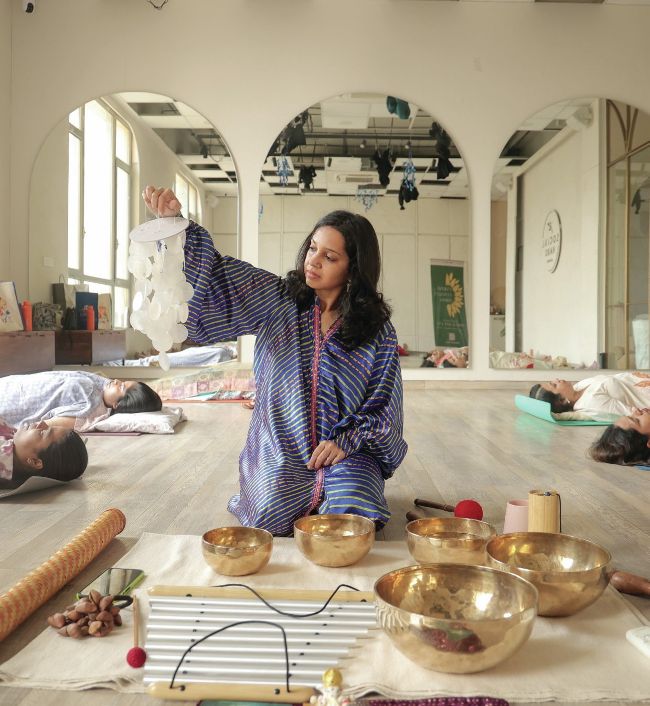
Sound baths, breathwork, and guided relaxation are often dismissed as luxuries. Both practitioners challenge that assumption. “These practices are regulatory interventions, not indulgences,” Lal explains, noting their ability to reduce cortisol and support parasympathetic activation. “And a regulated nervous system thinks and acts better.”
Chaphekar adds that stillness can initially feel uncomfortable. “When we slow the breath, when we lie still, the body begins to shift out of constant alert mode. Sometimes fatigue or emotion surfaces first, and that discomfort is released. When you’re not in survival mode, your decisions are less reactive. You can see things more objectively.”
LEADERSHIP AS NERVOUS SYSTEM STATE
For salon and spa owners, this conversation is not abstract, but it shapes culture and ethics. “Leadership isn’t just about skill. It’s about state,” Chaphekar says. “A regulated leader listens better and escalates less. Judgment becomes clearer because reactions are slower.”
Lal frames it in terms of safety. “A regulated leader creates psychological safety which directly improves team performance.” In environments where client experience depends on team cohesion, that regulation becomes strategic infrastructure.
REDEFINING WORK LIFE BALANCE
Today, work-life balance is reduced to dedicating equal hours to your professional and personal life. However, both Lal and Chaphekar disagree. “It is not about equal hours. It’s about whether your energy feels sustainable,” explains Chaphekar. “The real measure is whether you can tune out work externally and internally.”
Lal adds, “Balance is not time distribution; it is recovery distribution.” Effort must be matched with emotional, physical, and mental reset. Without recovery cycles, growth becomes erosion.
THE RHYTHM OF TRUE RECOVERY
A weekend away cannot undo months of overdrive. True recovery, both agree, is cumulative. “Recovery can start right here, right now,” Lal says, pointing to breath and stillness as immediate regulators. Longer recalibration may take weeks of consistent restorative practice.
Chaphekar agrees that distance alone does not equal rest. “True recovery is when your body actually softens and your breath slows down.” That softness can happen at home, provided boundaries and patterns shift.
For an industry built on caring for others, the message is timely. Occupational wellness is not a perk to be added once profits allow; it is infrastructure. When work rhythms are redesigned around regulation and recovery, performance becomes sustainable and leadership becomes steady.
In the end, resilience is not about pushing harder but about building work that allows people to return to themselves again.